
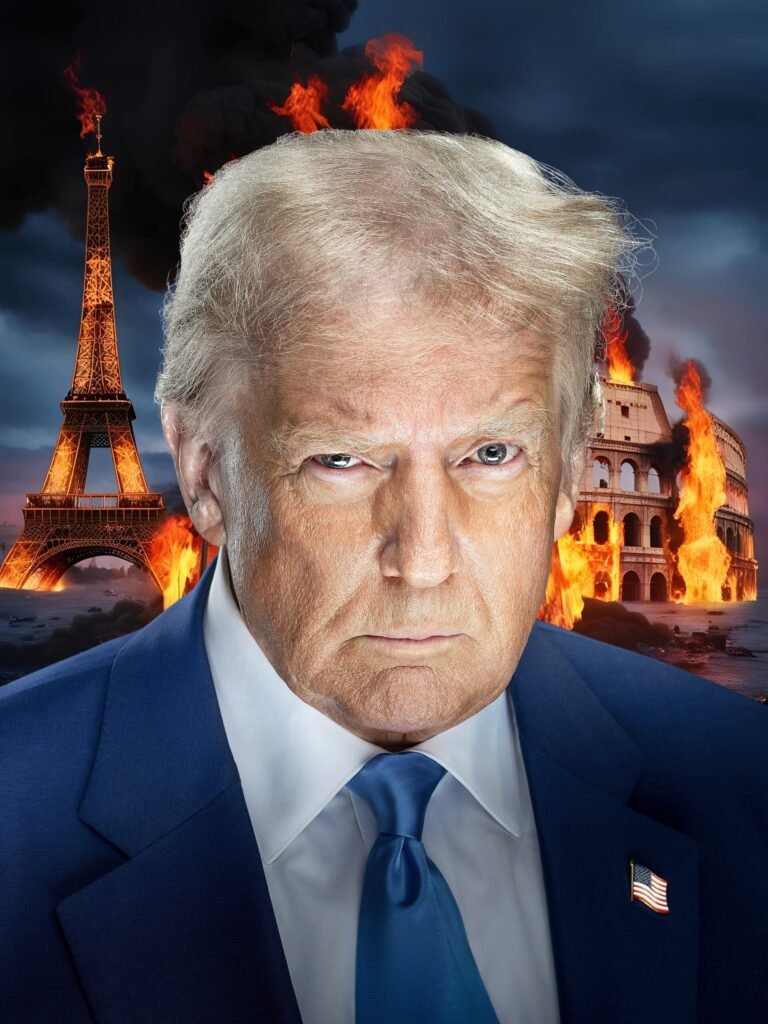
Trump “America is Me”: Ego, Gangsterism, and Diplomacy by Threat
Donald Trump today embodies a dangerous drift in international politics: the extreme personification of power, where national interests merge and blur with the unbridled ego of a single man. No longer “America First,” but “Trump First.” And this “Trump First” inevitably leads to the destruction of what he perceives as an obstacle to his egocentric worldview: the European Union.
Let’s be clear: it’s all about the money. The United States ran a budget deficit of nearly 7% in 2024. While this might seem small for countries like Italy, or even less so for others, for the United States it translates to a figure of almost $2 trillion. Money that must somehow be found, or someone must be persuaded to give it to them. By hook or by crook. In Trump’s case, by crook. By threatening and extorting money. Forcing European countries, sitting on a treasure accumulated wisely over the centuries, to “lend” the necessary sum by selling them American public debt repayable in 100 years, at very low interest rates. Some would call it a confiscation of funds. Others prefer to speak of extortion. Vulgar threats of tariffs, war (on the part of others, his friend Putin) and any other wickedness to force European countries to give him all the money he needs. In absolute disregard for long-term consequences, diplomatic relations, good taste, respect.
His diplomatic style is that of a gangster: bombastic threats, sneering arrogance, blatant contempt for anyone who does not align with his will. An attitude that aims to intimidate and subdue, to reduce every interlocutor to the role of vassal or enemy. Exemplary, in this sense, is the public humiliation inflicted on President Zelensky during their recent meeting at the White House (February 28, 2025). A media trap meticulously planned to discredit the Ukrainian leader in the eyes of the world, ridiculing him and undermining his credibility.
Gangster attitude, excesses, bombastic threats, contempt, and a general absolute lack of respect towards everything and everyone. Treating everyone as if they were humble subordinates or to be humiliated and subdued. This attitude, this way of managing international affairs that is characterizing Trump’s first steps as president, is already alarming and annoying those who are supposed to be, or perhaps we should already say were, the main partners and allies of the United States.
Not that Trump’s predecessors are free from criticism. We recall Obama’s empty presumption, convinced he could solve geopolitical complexities with the sheer force of his smile, and the disastrous management of the “Arab springs,” incubator of ISIS and detonator of instability and mass migrations towards an already fragile Europe. And what about the latest tenant of the White House, Joe Biden, a figure increasingly perceived as inadequate and faltering on the international stage?
In this leadership vacuum, the figure of Donald Trump emerges once again, not as a simple national leader, but as a true monarch, an emperor determined to shape the nation in his own image and likeness. His recent pronouncements and surreal videos about the Gaza Strip—which “He,” and we emphasize “He” and not the USA, intends to “buy” to transform it into a luxury Riviera—are not just manifestations of cynicism and contempt towards Palestinian humanity, already ravaged by a brutal conflict. They are the stark representation of a proprietary vision of the world, where entire nations and peoples are reduced to mere pawns or, worse, to objects to be bartered.
Europe in the Crosshairs: Dismantle to Dominate
And now we come to Europe, the designated target, the enemy to be brought down, the cumbersome memory that constantly recalls its origins as a colony of an unrivaled power. Its treasure to be plundered, looted. Because, let’s be clear, Europe—with its economic weight, its millennial history, its potential political force—represents an obstacle to Trump’s egocentric vision, an “uncomfortable” continent that, if only it could shake off its guilt complexes and media manipulations, if only it could truly unite, could become a global player of the first rank, challenging and perhaps even displacing, at least economically and politically, American hegemony. Hence, the strategy of disintegration, the will to dismantle piece by piece the European architecture, plundering it of its economic resources and delivering it, weak and divided, to Russian influence.
The temptation to destroy Europe is a cornerstone of Trump’s strategy. Indirect confirmation comes from the meeting with British Prime Minister Starmer, the first world leader received with full honors at the White House, and immediately rewarded with the promise of exemption from trade tariffs. A unilateral favor that sounds like an unequivocal message to Europe: divide and conquer. While the EU and Great Britain were attempting timid steps of rapprochement post-Brexit, Trump throws fuel on the fire of division, rewarding British defection and further isolating the continental bloc.
But why this anti-European obsession? The answer is simple: to subjugate the Old Continent to American will, transforming it into a kind of modern colony. Just as China has astutely exploited Russian weakness to bind it to itself and make it its own “armed wing,” Trump aims to exploit European fragility (divided, uncertain, undermined by populisms and internal rancor) to annihilate any vestige of autonomy and power. A weak and fragmented Europe is a Europe more easily controllable and exploitable, a reservoir of resources, skills, and low-cost labor, devoid of global ambitions and firmly anchored to the American orbit.
The Nefarious Pact with Putin: Sacrificing the East for Greenland?
The keystone of this plan of subjugation is a pact with Vladimir Putin. A cynical and unscrupulous agreement that envisions the partition of Europe into zones of influence, with the (self-interested) blessing of Washington. The sacrifice on the altar of realpolitik of the Baltic Republics and Eastern Europe, not very remunerative but of great historical value for Putin, destined to fall under the Russian sphere of influence in exchange for control and exploitation of Western Europe and perhaps a personal “favor” for Trump: the green light for the annexation of Greenland. A vast island rich in strategic resources, yet another “trophy” to exhibit as a symbol of newfound American (or rather, Trumpian) power.
In exchange for this capitulation of Eastern Europe, Trump hopes to obtain from Putin a loosening of ties with China. A dangerous illusion, born from a profound underestimation of the nature of the Putin regime. Because Putin, like anyone who will succeed him at the helm of Russia, harbors a historical obsession: the destruction of the West. And in this design, America, even Trump’s America, remains the number one enemy. A pact between two leaders ready to betray each other is destined to last for the space of a season. But in the meantime, the damage to Europe risks being irreparable.
The End of an Era: American Solitude and European Awakening?
With Trump’s strategy, an era a hundred years long of relations (albeit not always idyllic) between America and Europe closes. An era of cooperation, of shared values, of strategic alliances, which gives way to a new paradigm: that of ruthless competition, the law of the strongest, diplomacy of threat and contempt. An epochal change in the way international relations are understood, which risks plunging the world into chaos and fragmentation. The strategic solitude of Trump’s America is the most evident risk of this drift. An isolation that could prove fatal in the long run, especially in the face of China’s inexorable rise.
But the real unknown is Europe’s reaction. Will it be willing to be reduced to the role of vassal of an arrogant and despotic sovereign like Trump? Will it passively accept being sacrificed on the altar of a nefarious pact with Putin? Or will it be able to find the strength to rebel, to unite and to chart its own path, rediscovering its own identity and its role as a global protagonist? Perhaps, this apocalyptic scenario that Trump is helping to sketch out could paradoxically awaken Europe from its torpor. Push it to realize that the real danger is not only Putin, but also an unpredictable and hostile America. And the idea of a conflict with the United States, once unthinkable, is no longer science fiction today, but a concrete scenario that is beginning to creep into the corridors of European power.


